Supervisor Ordered An Employee Who Got Bitten By The Boss's Dog To Finish His Shift Instead Of Going To The Hospital

A workplace dog bite is bad enough, but being told to keep working after it happens takes things to another level. In this Reddit story, an employee is dealing with a boss who brought an aggressive dog into the office, then acted like the injury was no big deal.
What starts as an unexpected office visit quickly turns into a safety nightmare when the dog is unleashed, growling, and eventually bites OP's leg. Instead of sending him to get medical care, the boss wants him to finish the shift, which is exactly the kind of decision that makes coworkers and readers furious.
Now the question is whether this was just reckless, or something much worse. Read on.
Some of OP's colleagues asked their boss to keep the dog inside his office, but he refused because his dog was a good boy

The dog was outside OP's cubicle and suddenly bit OP's leg with no provocation
OP yelled, and his coworkers gathered around him. During the commotion, OP's boss finally leashed his dog, but the damage had been done.
OP's boss blamed him for everything, and when OP expressed his intention to go to the hospital, his supervisor told him to finish his shift; however, they backed down when OP threatened to sue.

This is not a simple issue that management can cover up with a pizza party

The boss's reaction is where this story really goes off the rails.
In this case, the supervisor's decision can be viewed as a violation of both ethical standards and possibly labor laws.
Additionally, such decisions may create a culture of fear and mistrust within the workplace.
OP is absolutely right to prioritize his health first. You don't join the anti-work subreddit without learning a thing or two.

OP's boss must face the consequences of his negligence

He is in serious trouble, and after an incident like this, he might not be a boss for too long

That kind of response only makes the situation look worse.
While the idea of allowing pets in the workplace might seem appealing, the incident involving an employee bitten by the boss's dog starkly illustrates the potential dangers of this practice. The expectation for the injured worker to finish his shift, rather than seek medical attention, raises serious concerns about employee welfare and management's responsibility in such environments. Although pets may create a more inviting atmosphere, as seen in this case, they also necessitate stringent oversight to prevent accidents and ensure a safe working environment. The balance between fostering morale and maintaining safety is precarious, and this situation serves as a cautionary tale about the risks that can arise when those responsibilities are neglected.
OP should get a really good lawyer to get all of the paperwork in order

You cannot downplay how serious rabies is

It is not out of the realm of possibility that OP's boss is not a responsible dog owner based on his reaction to what happened

People in the comments are not buying the boss's excuses.
This also echoes the coworker whose untrained, scared dog barks and disrupts the workplace.
In this instance, the dog biting an employee could reflect poor training or supervision on the part of the owner.
Employers must take proactive steps to mitigate these risks.
The moment OP is out of the danger zone, he should seriously consider taking his boss to court
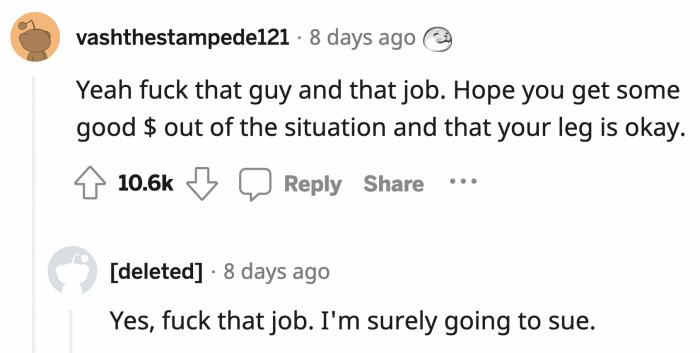
There are plenty of witnesses, and let's hope they are willing to side with OP

Simple, succinct, effective

That is not the kind of mistake you can shrug off.
Addressing Injuries in the Workplace
Injuries should always be addressed immediately to prevent further harm and demonstrate that employee well-being is a priority.
OP can either ask his lawyer to obtain the CCTV footage, but in case the boss has any funny ideas about deleting it, it can't hurt to ask his former colleagues for help

It is unfortunate that there are irresponsible dog owners who seem to think their dogs can do no wrong. If you do not train your animal, refuse to leash it, and take no responsibility when another person is affected, then you have no business owning a dog.
Dog bites are not something you can overlook either; rabies is literally life-threatening. Hopefully, OP's boss realizes how badly he messed up and how much he and his company will have to pay.
Moreover, training on animal behavior and safety for all employees can help mitigate risks associated with workplace pets.
Such training can empower employees to act confidently and safely in the presence of animals.
The Consequences of Poor Management Practices
Poor management practices can lead to serious repercussions, not only for the individual involved but also for the organization as a whole.
Implementing thorough training programs and safety protocols can help prevent such incidents from occurring in the first place. Educational initiatives focused on safety and responsibility can create a safer and more positive work environment.
Investing in employee well-being is not just ethical; it's also economically savvy.
The incident involving an employee who was bitten by the boss's dog and then ordered to finish his shift instead of seeking medical attention highlights a troubling disregard for workplace safety. This scenario echoes previous concerns about employee treatment, similar to the alarming reports about Amazon workers being forced to choose between their well-being and productivity. The prioritization of safety is non-negotiable; when organizations overlook such fundamental responsibilities, they jeopardize not only individual health but also overall morale.
Creating a culture that values employee welfare is essential for fostering engagement and productivity. This situation raises questions about the ethical management practices in place and whether companies truly understand the implications of their decisions on employee safety.
After a boss’s dog bite, what would you do about a coworker’s dog peeing in the lab office? Read the Redditor’s biohazard pee problem.
Share this article: